Showing posts with label photographers. Show all posts

Friday, February 28, 2014


Happy Friday! & Happy birthday to meeee! I'm unsure of what the weekend holds for birthday festivities but I hope all around its a lot of alcohol and positive vibes. I spent all day yesterday in the hospital so basically the only cure is those two remedies. Hope you all are planning an amazing, relaxing weekend. 

This week I am discussing an American woman photographer, Sally Mann. She is ultimately known for her large-scale black and white portraits. My favorite collection of her work can be found in her, Immediate Family, photographic book that was published in 1992. The images are a collection of her children, all under the age of 10, participating in daily activities. The book caused a lot of controversy because many critics thought of it as child pornography and neglect. She has contradicted the critics by saying her photographs are, "natural through the eyes of a mother, since she has seen her children in every state: happy, sad, playful, sick, bloodied, angry, and even naked." Currently, she lives on farm in Virginia and is represented by the Gagosian Gallery in New York City and the Edwynn Houk Gallery in New York City. 


All images © Sally Mann. 


Here's what I'm listening to:
&


Friday, February 7, 2014


Nan Goldin. A name synonymous with portrait photography. Her work captures the most intimate of moments between individuals, shockingly because of the introduction of a camera. As described by one of her current gallery exhibitions, "As a teenager in Boston in the 1960s, then in New York starting in the 1970s, Nan Goldin has taken intensely personal, spontaneous, sexual, and transgressive photographs of her family, friends, and lovers. In 1979 she presented her first slideshow in a New York nightclub, her rightly colored, snapshot like photographs were soon heralded as a groundbreaking contribution to photography." She currently lives in Paris and New York. 

Her work is something that I wish I was personally more comfortable with shooting. She seems to have no boundaries between individuals and you can feel her intensely personal relationships with the subjects. 


All images © Nan Goldin. 


Here's what I'm listening to:


Friday, January 31, 2014

Thank fucking god its Friday. AMIRIGHT. Not really though… I'll be spending my weekend studying for midterms that I have next week. Yup you heard it here folks.. midterms! & it's not even February yet.. well it will be next week but #ugh. My school is a lot of work & sometimes it just really sucks. On  a more positive note, my favorite part of the week is here, friday obviously, but photographer friday!!


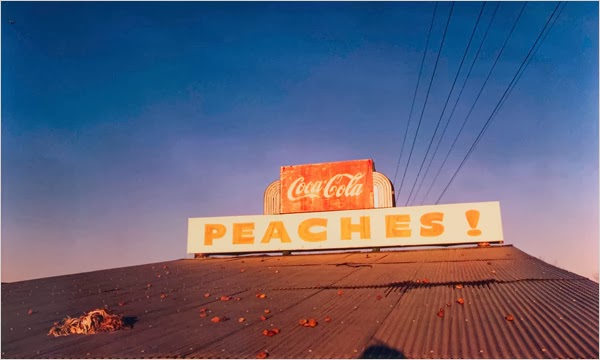
William Eggleston is an American color photographer born in Tennessee (I suck at American geography, I had to spell check Tennessee how embarrassing). He exhibits work similar to Stephen Shore, as in he is drawn to the ordinary. Again, something I find myself drawn to as well. Recently, three dozen of his large format prints were sold $5.9 million in an auction at Chritie's to benefit his own organization, Eggleston Artistic Trust. Which sounds like a loud of crap to me because it's his own organization to preserve his own images. One of his prints set a world auction record for 'single print by the photographer' for $578,000. He has been quoted saying, "I only photograph one thing one time." As a photographer I find that extremely hard to believe. In order to get the perfection he is able to achieve in every shot (compositionally, etc.) there is just no way. There is also just no point. Why only photograph something one time? If you have the option to photograph it a few times at a few different angles, distances, etc., why not? How do you know that just stepping a few feet back won't completely change the image in an amazing way? Or flipping it from horizontal to vertical won't redefine the image and the subject? Whether his remark is true or not, his imagery is beautiful. 


All images © William Eggleston


Here's what I'm listening to:
&


Friday, January 24, 2014

Ugh I've been so bad this week at posting! My apologies!! Between the snow days, catching up with class work, have a zillion tests on this morning, and on top of that, having the worst cold of the century, it has set me behind a shit-ton. I have mostly been spending my time cowering under my blankets with multiple rolls of toilet paper to blow my nose into and sipping on tea and honey. Send positive energy to make me feel better because I haven't felt this shitty in awhile. :(

Enough about me, its Photographer Friday!! Yay! 


This week I wanted to introduce an iconic photographer, Stephen Shore. The past few weeks I was posting about more portrait-driven photographers, while Shore relates more to what I tend to shoot. His stuff is absolutely amazing and is absolutely inspiring to me on every level. I feel more of a connection to his work than the last few photographers. Yes, McGinley and Collins create beautiful images, but their work is something that I wish I was confident enough to partake in, while Shore's work is something I find myself more drawn to when I am behind the camera. 

Stephen Shore is another American photographer, who works primarily with film. He began using 35mm, and then medium format, and eventually into the world of large format, or 8x10. For those of you who have no idea what I am talking about, I will post images below with what these types of film cameras are. Large format allows the photographer to work with the largest size negative, which allows them in the darkroom to create beautiful, larger images, without losing any detail. Anyway, Shore has managed to create beauty in the seemingly banal scenes in American landscape. It is pure beauty and has always been an inspiration. He is alive and well today and is the director of photography at Bard College. 


All photographs © Stephen Shore


For those of you who have no idea what I was talking about in terms of cameras, let me teach you all briefly about the beautiful and lovely world of film photography! A lot of modern day photographers and artists consider film a dead art, but if one is interested in a more fine art approach to the arts, I think film is the only way to go. Personally, when I am creating a film image, my work is so much closer to me. When I am snapping away with a DSLR, (digital single-lens reflex camera) I never feel the same connection to my work. Film has much more of a process and everything must be correct the first time around. Sure, you can correct for a lot of things in the darkroom, but if you had just gotten in correct the first time around you would spend significantly less time and money correcting. There is also a limited amount of images that one can take so every photograph you think that you see, you must be pretty sure that this is something you want to capture. With digital, everything is just click click click and then delete later. You basically have unlimited attempts with little to no consequence at an image. If you are a complete novice with the workings of a camera and what all of the lingo means, thats okay you can be a pro on photoshop and fix it all later. Which I strongly disagree with

Anyway, the cameras I was discussing earlier were 35mm, medium format (120), and large format (8x10). Each camera produces different sizes and works with different size negatives, and it is truly up to the photographer themselves what they would like to deal with. 35mm is the most common now because of it is easy and portable. Medium format is also somewhat still popular because, again it is easy and portable. Large format is not portable for a long shoot by any means. I would not take my large format camera and walk around the city all day just hoping to find an image. The benefit to large format is being able to capture and keep a lot of detail in the image. The smaller the negative is and the larger you want your image to be, the more you enlarge it in an enlarger in the darkroom, the more information you are losing. Larger negatives allow for larger prints and a lot more detail within the image. Each has a very different process in which the image is projected onto it's negative and then later how it is processed in the darkroom. There is so much information about photography, especially film, that I feel needs to be shared because so many individuals have not even an inclining about it. It is a lovely form of art that I think should be taken advantage of more on a daily basis, way more so than using anything digital. If anyone has any questions, needs something elaborated on, or ever needs to know anything about photography, please, please contact me! I am always willing to help and to educate! (I'm sorry for writing so much today but I miss practicing photography full-time so this was somewhat of a rant for me.)


35mm film camera


A medium format, 120mm, camera. This camera is also twin-reflex lens.

Medium format, 120mm, single-lens reflex. 

Large format, 8x10, on a tripod. 

Large format camera, 8x10

DSLR 


Friday, January 17, 2014


TGIF!! That means another round of Photography Friday here. Hope everyone had a wonderful week and are bracing themselves for a weekend of hopefully drunken escapades. Maybe I have inspired you enough to begin to photograph and document such escapades? No interesting story started with drinking a glass of water. 

So this week I wanted to exhibit a pretty well known photographer in the art world: Ryan McGinley. If you aren't familiar with his work it is all beautiful film pieces that amaze me every time I look at them. He and my last week's feature's work, Petra Collins, remind me of each other. He has even photographed her. A lot of focus on the human body and form as well as the strange activities that separate us from one another, the two tend to focus on. They are also extremely interested in the preservation and study of youth and youth culture. 

McGinley, born in 1998, is an American photographer based out of New York City. He is local to the area and he and I both grew up in NJ. He also attended the same university as I, Parsons The New School for Design, although he did not study photography while he was there. His work has been exhibited around the world and particularly in New York City. He is featured in the public collections in the Guggenheim Museum, The Whitney, and more. His work has been described as, "freezing a stage in a lifetime. Young and beautiful is as fleeting as a camera snap -- and thus all the more worth preserving." 


© Ryan McGinley 2013 - Body Loud


© Ryan McGinley 2013 - 2013


All images copyrighted © Ryan McGinley 2013